

BLUF: Talk of a tipping point at the start of June, after which global oil inventories pass an operational stress level and prices rise even further, seems reasonable. Strains on supply are increasingly shifting toward oil products used in transportation, a trend that neither slack in global supply nor trimmed demand are likely to alleviate. Trump’s apparent desire to continue pressing Iran, the difficulty of de-mining the Strait before the end of summer, and the option of a U.S. export ban make it likely that the impasse in the Strait and oil product price increases continue into the summer.
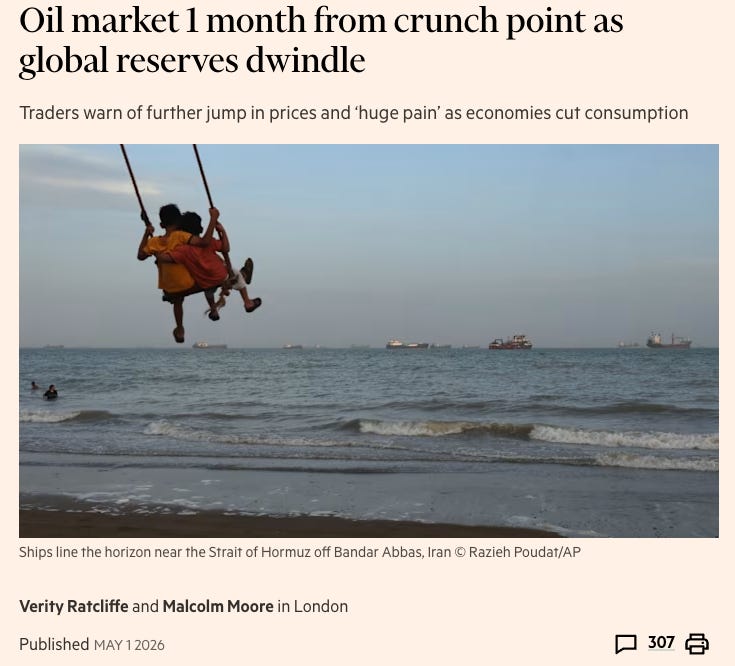
“Tipping point.” I’ve read the term (or something like it) several times over the last week in news coverage of the ongoing conflict in the Strait of Hormuz, where claims of an ongoing ceasefire bump up against the reality of, most recently, U.S. airstrikes on two Iranian-flagged tankers. “An inevitable market reckoning is coming,” said S&P’s head of crude research this week; “the tipping point is clearly June,” a large oil trading firm’s head of research claimed one week ago. “We are going to start to see some import-dependent countries potentially start to face critical shortages as we get into the June-July timeframe,” ConocoPhillips’ CFO said at the end of April. “Oil market 1 month from crunch point,” read an FT headline on May 1.
Why worry that June is a hinge point? The clearest articulation comes from Natasha Kaneva and commodities researchers at JPMorgan. Per the FT this past week:
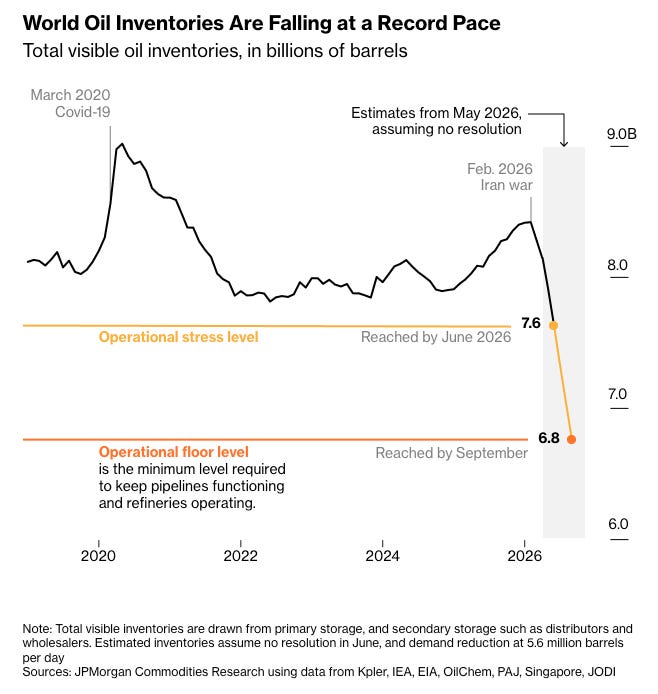
Given the magnitude of the demand pullback, our balance now suggests OECD commercial inventories are on track to approach operational stress levels by early June.
Again, we see the same tipping point language: the risk is a “non-linear spike in oil prices.” There are three components:
1. Oil inventories will reach functional limitations before additional capacity can come online.
The piece quoting Kaneva (May 5) points out that, according to JPMorgan, only about 10 percent of the estimated 8.4 billion barrels of global inventory “are realistically available without pushing the system into operational stress,” as multiple points in the system require threshold amounts of oil to function properly. Pipelines without any oil inside lack the pressure needed to move product around; near-empty storage tanks at terminals can’t transfer oil to tankers quickly; and refineries without reliable access to a variety of crude slates will not operate profitably.
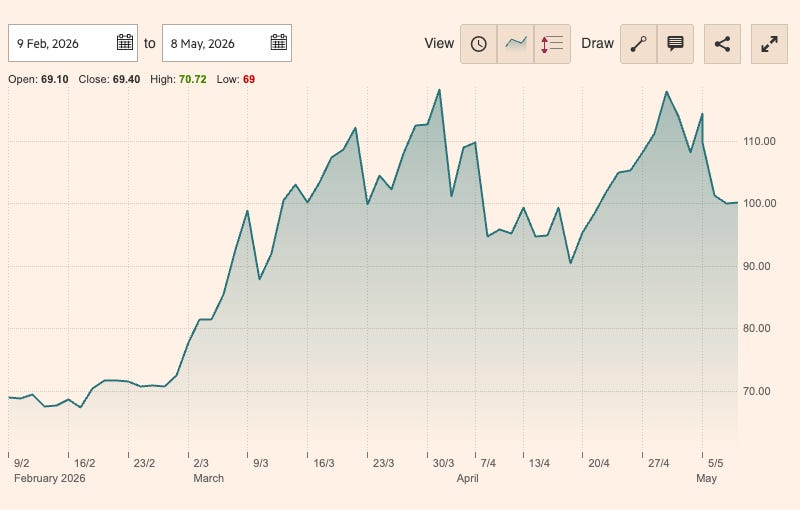
S&P Global Energy estimates that the war has taken about 1 billion barrels of crude off the market and that crude stockpiles fell by just under 200 million barrels in April. The important thing to note here on the supply side is that if there is any hope of crude output ramping up enough to meet these gaps in the short term, markets do not seem to have gotten the memo. Brent crude prices were, at their highest, up about 62 percent since the start of the war and now are up nearly 40 percent — not a sign that traders expect more product to come gushing in. Markets and states are adapting, of course, but SPR releases, Jones Act waivers, and rerouting have not been enough to close the supply shortfall at least until 2027, according to the IEA.

Research indicates that oil producers care less whether prices are up and more about the stability of the market. Wild price swings like those occurring now discourage investment. U.S. executives confirmed this in comments published in late April by the Federal Reserve Bank of Dallas, with one noting that “The unpredictable nature of the current administration makes business modeling near impossible.” Partly because there appear to be no publicly available, precise inventories of foreign country inventories, and because U.S. crude inventories remain at a solid 850-ish million barrels despite steady reductions since April, it’s not certain when the supply will exactly pinch. But suffice to say that U.S. producers are not going to make up for the shortfall alone.
On the lack of slack among U.S. producers, a Lex piece from this week summed it up nicely (bolding mine):
The problem, here, is that US shale fracking is a complex logistical effort, with a supply chain involving trucks, rigs, pipes, water and sand, among the various elements. There is some slack in the system, but not a huge amount. There are between 10 and 15 per cent fewer rigs in use now than there were in 2024, so some extras may be lying about. But for some of the most sought-after components, utilisation is above 90 per cent, according to WoodMackenzie.
That suggests that, should everyone do a Diamondback, they would quickly bump up against logistical constraints. And that, inevitably, means that the price of the supply chain components that run short would rise too.
2. Demand destruction will probably not be large enough to alleviate the supply crunch.
That would all be good and well if the steep price increases in oil products were enough to curb demand — in other words, if demand destruction was sufficiently large to balance supply shortfalls. But, as the IEA chart above shows, the consensus estimate is that demand destruction will not be enough.
This is more than anything a reflection of the fact that short-term demand for oil products is highly inelastic.1 Many industries are built around trucks, cars, planes, ships, and electricity generation that require oil products. Retooling all of this to run on alternate power sources is simply not feasible in the short term.
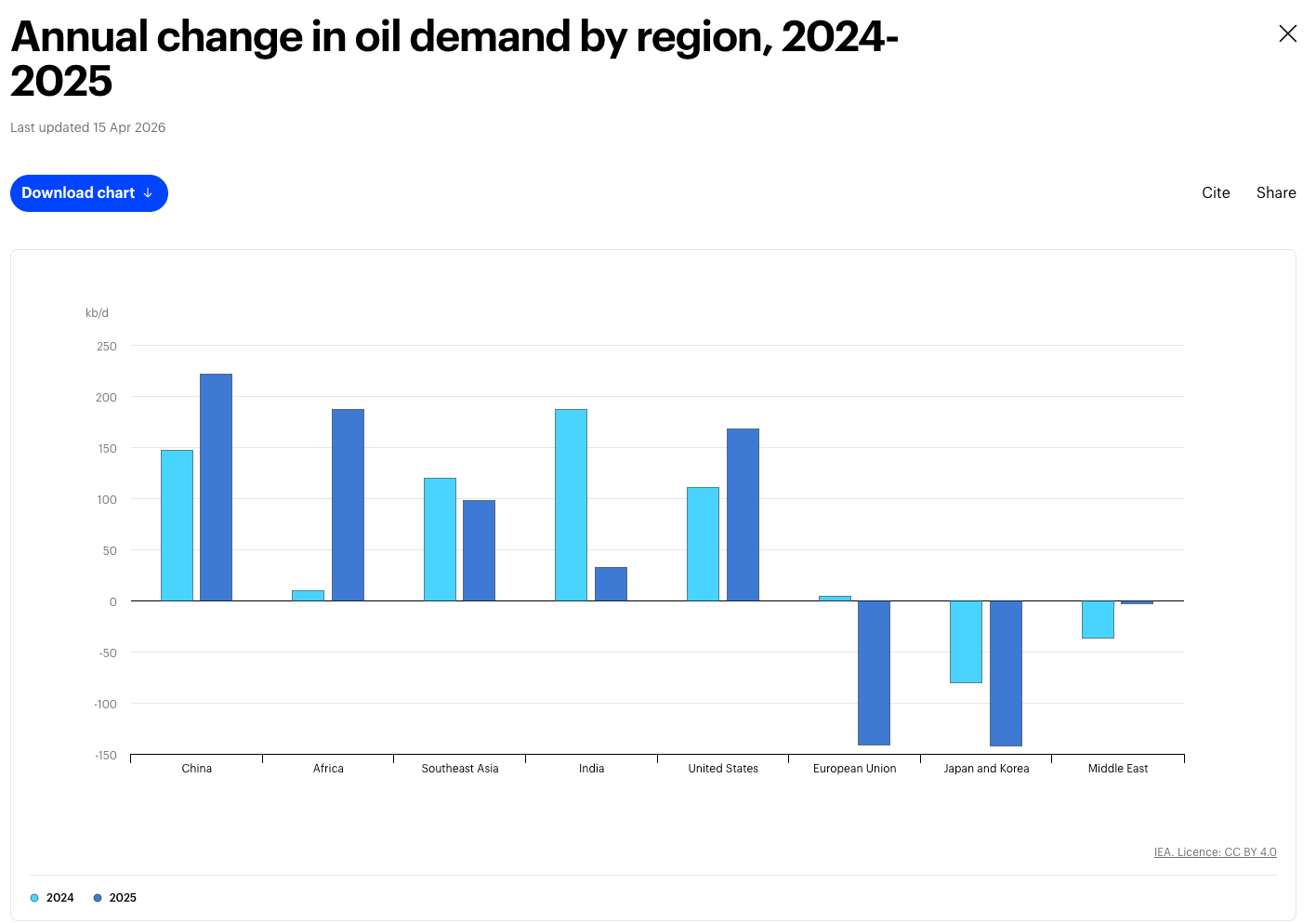
Consider that S&P Global Energy estimated that in April global demand fell by 5 million barrels/day due to increased prices. That absolutely dwarfs the total decline in oil demand in 2025 of 285,000 barrels/day — by a factor of 17 to 18 — among the EU, Japan, South Korea, and the Middle East, the regions whose demand declined from 2024 to 2025. And even then, the demand destruction was 1.6 million barrels/day short of the decrease in supply, of 6.6 million barrels/day.
Of course, as the crisis deepens and prices of oil products continue to rise, the countervailing force of demand destruction may grow stronger still. This “sanguine” take on the market as a sufficient balancer, however, has problems — I’ll get into that more below when discussing counterarguments against the tipping point thesis.
Many industries are built around trucks, cars, planes, ships, and electricity generation that require oil products. Retooling all of this to run on alternate power sources is simply not feasible in the short term.
3. The Trump administration may opt for an export ban, prolonging shocks to global supply by insulating U.S. consumers from shortages.
Less explicit in the tipping point thesis but no less crucial is the question of U.S. room to maneuver. All else equal, a supply crunch is less concerning if the actor with arguably the most agency to alleviate the crunch — the United States — feels more compelled to revise its negotiating terms, which could pave the way for a temporary settlement with Tehran that allows for increased traffic in the Strait. But what if Washington buys itself more time? It’s probably fair to say that, in general, Trump is more sensitive to the American electorate and elites than to the opinion of allies and the international community.
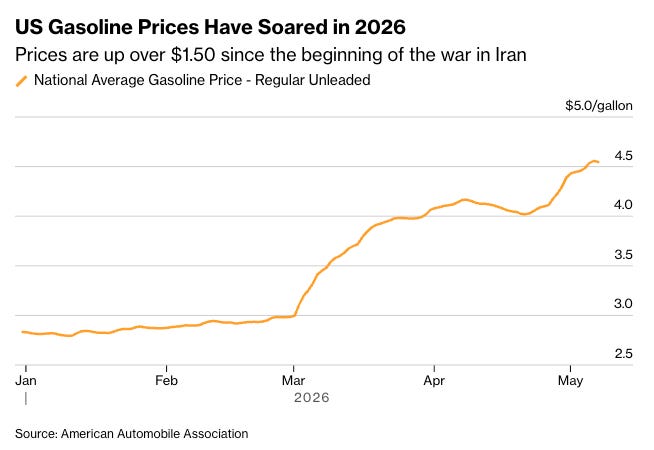
The increasing gas prices that represent the largest domestic pain point for Trump need not be, however. They reflect that oil is still traded globally — shortages in the Strait have made the stuff scarcer and thus pricier for consumers across the world, including in America. An export ban would prevent U.S. oil producers, who are right now helping plug the global gap in supply, from sending their product abroad, pushing prices down for Americans.
While the Trump administration has consistently denied since March that it will opt for an export ban, if you add up insufficient supply, how long that would take to change given de-mining realities, insufficiently declining demand, and the seeming unwillingness of Trump to budge vis-à-vis Iran, there are few areas to go other than a ban. One can only waive the Jones Act so many times. Hence, traders are betting that the spread between WTI (U.S.) and Brent crude (world) oil prices will cross $45 a barrel — a bet on an export ban. From Bloomberg (May 5):
Positions have been building in put options — now totaling the equivalent of some 22 million barrels across contracts from July through November — betting on the spread between WTI and Brent crude reaching $45 a barrel, from a July level of just over $13 now.
While the July WTI-Brent spread settled at -$9.29 a barrel on Friday, May 8 — less than the spread of -$11.63 per barrel a week earlier and far less than that of -$20.69 at the peak in March — the volume of put options is still rational. The quantifiably more volatile oil market is anyone’s guess, for Trump’s tolerance for economic pain is unclear. It is easier to imagine him finding a way to prolong his position in the conflict — including via an export ban — than it is to describe with precision his willingness to concede on the many issues at stake, according to him, in the war against Iran.
While the Trump administration has consistently denied since March that it will opt for an export ban, if you add up insufficient supply, how long that would take to change given de-mining realities, insufficiently declining demand, and the seeming unwillingness of Trump to budge vis-à-vis Iran, there are few areas to go other than a ban.
Counterarguments: Less than Convincing
Pushing against the tipping point thesis are two realities. The first is that the crisis and the high oil prices it has created have already produced moderating tendencies, on the supply side in the form of government efforts to redirect and increase supply and on the demand side in the form of demand destruction. I think the evidence above shows these tendencies to be insufficient. The second counterargument is that, for all of the lost face that would accompany a U.S. backdown from Trump’s current maximalist position vis-à-vis Iran, Trump backing down is plausible enough that Iranian leadership feels comfortable betting on it. The U.S. position on Iran is an elite one; Tehran is counting on ground realities (namely, the lack of American public support for a maximalist position) eroding that position. And so Washington may simply fold.
In a word: Iran is far from the U.S., so perhaps Trump can call it quits there easier than, say, Putin can his war in Ukraine.
But these two tendencies are in tension with one another. The more that the Trump administration thinks world efforts and markets have already alleviated the price and shortage issues caused by the war, the stronger it’ll think its own position at the bargaining table. Which means more holding out against Iran, and more time to try workaround schemes like Navy escorts and, possibly, a resumption of airstrikes (as well as, in the longer term, ideas like drilling under U.S. military bases). And less odds of U.S. capitulation by Memorial Day.
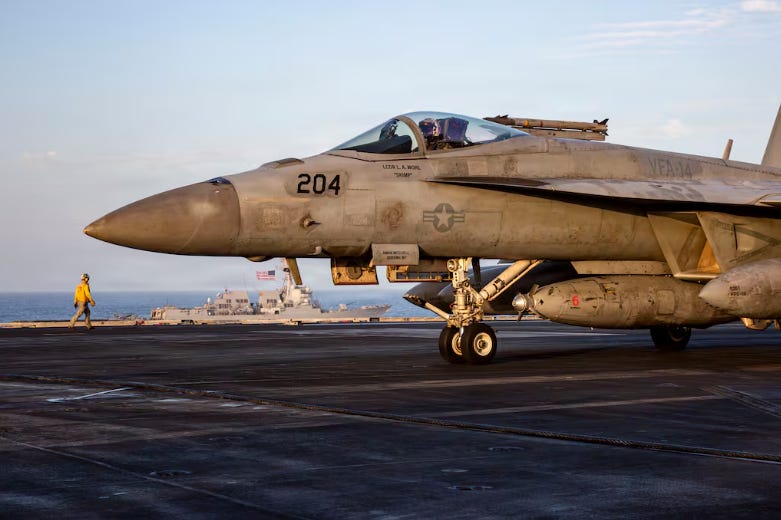
What U.S. leaders believe they can afford is all-important here. After all, it’s what precipitated the crisis. Only with a preponderance of U.S. military power in the Middle East do we get a Trump administration confident enough to intervene with Israel in February; only with such a swift decapitation strike does Tehran pull out its ultimate weapon of choking off traffic in the Strait; and only with such a persistent asymmetry in military power over the past half-century does Tehran even think in the first place to build up such a reliable arsenal of anti-ship missiles, missile boats, mines, and well-distributed, hard-to-target forces to which the might of U.S. Air Force or carrier strike group has no sufficient answer.
The more that the Trump administration thinks world efforts and markets have already alleviated the price and shortage issues caused by the war, the stronger it’ll think its own position at the bargaining table.
Changing Character of Demand Destruction
Again, trying to predict Trump’s negotiating thresholds is difficult — hence the reduced trading volume in oil and the tail risk hedging around an export ban. The market forces, however, are easier to address. Returning to the last part of point #2 above — that demand destruction may be able to close the supply gap in coming months without a step function increase in felt disruption — there are a few reasons to believe this won’t happen.
For one, the demand destruction seen in the first few months of the war — 2.8 million b/d in March, 4.3 million b/d in April, and expected 5.5 million b/d in May, according to the aforementioned JPMorgan analysis — will not proceed as before. The nature of shortages will change. The past two months pinched petrochemicals used in heating, plastics, and other manufactures the most. The IEA’s April Oil Market Report (bolding mine):
Within the product complex, petrochemical feedstocks display the most immediate effects of the war by far, as the blockage of the Strait of Hormuz has thrown supply chains to Asia into disarray. LPG/ethane and naphtha account for the bulk of April’s drop, down by 1.8 mb/d. Compared to 8% and 9% y-o-y declines in the two feedstocks, decreases in transport fuels are comparatively modest, with gasoil, gasoline and jet/kerosene’s contracting by around 1% each in April.
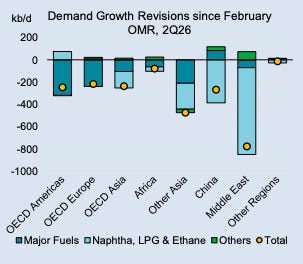
All else equal, we should expect pinches more and more “in areas where there is no substitute, like road or air freight and maritime shipping,” as one analyst describing the problem put it. This is downstream of increasing oil intensity over the half century, a product of increasing efficiency and diversification away from oil. As the JPMorgan analysts framed it on Friday, supply shortages are “increasingly being pushed down the barrel, out of crude and into refined products,” which includes petrol, diesel, and jet fuel.
That is all to say, one cannot count on demand destruction to save consumers if it that destruction increasingly targets consumers. To the counterpoint that prompt oil prices should be even higher if June was really a tipping point: well, markets have shown themselves unable to pin down just how far Trump wants to take this. And some of the tools governments have counted on (or may count on, in the U.S. case) to insulate consumers — fuel subsidies and export bans — are taking us to the operational stress point faster. The tipping point thesis grows stronger once one considers that the padding in the global energy system that has taken us through March and April will not be nearly as capable by the summer.
Lastly, those betting on long-term demand destruction will find it hard to address the point that countries will likely hoard oil more aggressively after this crisis than before. What other lessons could a rational state take away from this episode? As one American oil executive said on May 8, “Post-war, we would not be surprised to see several countries restock their SPRs above pre-war levels, essentially creating an additional layer of demand into the future.”
The Adversary’s Vote
Finally, to return to what Trump will try to do: while his perception of the early summer tipping point is not clear, we can at least be moderately confident on what the other side will not do: concede. This judgment can’t be certain — after all, most in the West did not predict the scale of protests in Iran earlier this year — but Tehran seems to have its bases covered in the Strait, at home, and diplomatically.
In the Strait, it doesn’t seem anything has changed the simple fact that Iran has, by the threat of even one anti-ship ballistic missile or missile boat getting through, or even one mine detonating against a supertanker hull, secured control over traffic through the Strait. “All it takes is one drone to hit a ship and no one will give insurance,” said one Israeli analyst to the Washington Post last week. Those who instead go on about the number of U.S. sorties or targets destroyed are more or less rehashing McNamara’s body count metric from Vietnam. These grim military metrics do not meaningfully change the strategic picture — a picture dictated by the reality that, as Bryan Clark reminded ChinaTalk listeners back in March, forget about Iran’s coastline caves: metro areas with populations in the hundreds of thousands dot Iranian territory hugging the Strait.
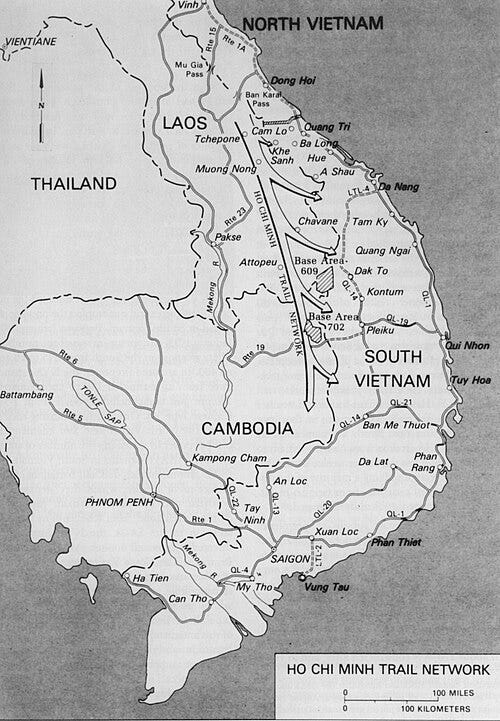
The distance between these potential hiding spots and Strait traffic routes ranges from dozens to just a few kilometers. A few thousand U.S. sorties — unless they are conducted with nuclear weapons — are not going to be able to clear out every potential hiding place. Hence, the confident tone of the initial air campaign has given way to the reality that, according to the CIA, Iran’s 2,500+ ballistic missile and much larger drone stockpile before the war is nowhere near depleted. (The danger with precise airpower is that the more precise it is, the more effort the enemy will put into things like hiding, digging, and otherwise avoiding. See: the Ho Chi Minh trail.)
Regarding Iran’s home-front, the disconnect between modern history and U.S. elites’ theories of airpower and strangulation seems as large as ever. Robert Pape’s Bombing to Win has enjoyed a resurgence since March because its story, I think, is mostly correct. If Country A cannot either make continued war absolutely unthinkable for Country B or cannot at least show Country B it is dedicated enough to the fight to put large numbers of ground forces in Country B, then the latter will probably be able to continue the fight — even if many of its citizens are tired, hungry, or fed up. (And especially if, as in Iran’s case, security forces have recently demonstrated their hold over the population.)
The danger with precise airpower is that the more precise it is, the more effort the enemy will put into things like hiding, digging, and otherwise avoiding. See: the Ho Chi Minh trail.
Airpower on its own is paradoxically weak because it can cause civilian leaders to believe they can impose their will without the costly step of sending ground forces to hold enemy territory, a process that is almost certainly bound to produce casualties. The notion that Israeli and American airpower could translate tactical might into strategic effect founders because the Iranian people — deprived by Iranian domestic security forces for decades of any institutions that may facilitate collective action or other tools that may allow for violent resistance — would have little reason to take up arms against a regime that could simply wait out the bombing campaign. Those who’d like to resist the regime, as well as regime officials, are all asking themselves: How much do Israel and America really care about what happens in Iran if they can’t even bring themselves to send troops here? Those controlling things in Tehran, especially after the violent deaths of the previous cohort of leaders, seem inclined to call bluff. The man on the scene with the gun is still what matters.
Of course, Country A can make war unthinkable for Country B by means other than bloody occupation. It can choke off the economy of Country B from afar. But the CIA estimate that Iran could likely face down another three to six months of U.S. blockade before “facing more severe economic hardship” merely confirms the historical pattern of blockades. Any moderately large country has the economic flexibility to adapt to blockades or sanctions; successful blockades must thus be measured in years, not months. And these successful cases seem to crop up only when the country doing the blockading is also fully at war with the target country. This is what the U.S. experience has been, at least, from the Union stranglehold on the Confederacy to the starvation of Germany in World War I and Japan in World War II, all of which took years to effect.
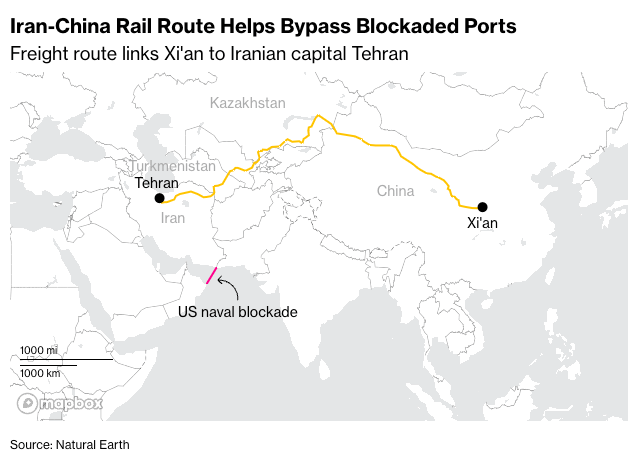
To that point: what exactly can the U.S. do given that Iran is not an island? Things do not work out well for blockaders or counterinsurgents who cannot fully seal the target off, whether that target is the North Vietnamese who found supplies and sanctuary in the Soviet Union and the PRC, or the Algerians who (before French interdiction) found them in Tunisia and Morocco, or the mujahideen fighting the Soviets who found them in Pakistan. If great-power backers make clear they will sustain a target country’s war effort, how can one convince that country’s leaders to give up? Per Bloomberg:
The number of cargo trains going from Xi’an in central China to the Iranian capital Tehran has risen from around one per week before the conflict to one every three or four days since the start of blockade on April 13, according to people with knowledge of the shipments.
Freight costs have surged, with quotes for shipping a standard 40-foot container along the route as high as $7,000 this week, roughly 40% more than typical levels, the people said, speaking on condition of anonymity as they aren’t authorized to speak with the media.
There is also that body of water north of Iran. China is not the only great power with an interest in backing Iran. Per the NYT (bolding mine):
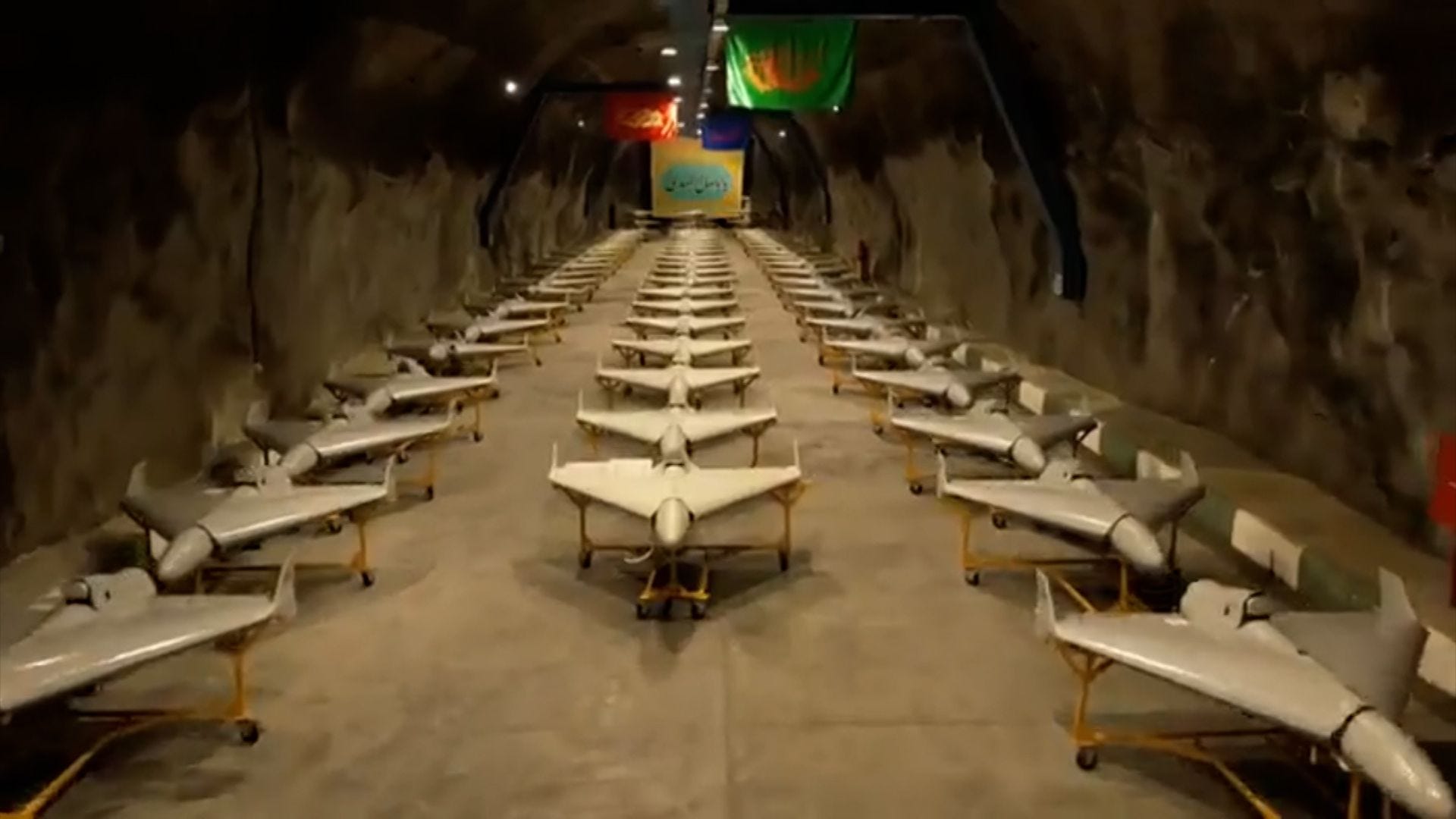
Russia is shipping drone components to Iran via the Caspian Sea, U.S. officials say, helping Iran rebuild its offensive abilities after losing roughly 60 percent of its drone arsenal during recent fighting. The officials spoke anonymously to divulge private military assessments.
Russia also provides goods that would typically pass through the Strait of Hormuz, now blockaded by the U.S. Navy, as part of global trade.
Iranian officials have said that efforts to open alternative trade routes are progressing rapidly, with four Iranian ports along the Caspian working around the clock to bring in wheat, corn, animal feed, sunflower oil and other supplies. Mohammad Reza Mortazavi, the head of the Association of Iran’s Food Industries, told the state broadcaster IRIB that Iran is actively rerouting essential food imports through the Caspian.
This support from great powers forms the last leg of Iran’s strategic stool. While Russia’s calculus seems to simply be “support Iran,” given that U.S. power and attention diverted from Ukraine is necessarily to Moscow’s benefit and that Russia reaps plenty from greater oil scarcity, Beijing’s calculus is more complicated. Xi Jinping’s country is not at war; economic stability is still a key consideration. And China’s prewar trade volume with Arab states under attack by Tehran, like Saudi Arabia and the UAE, was much larger than that with Iran.
It seems likely that Trump will try to push against Iran’s strong position by appealing to Xi at their summit this coming week. I don’t know if there’s enough information available to assess how Xi will handle this. It seems two interests of his are in tension. On the one hand, he may want to genuinely pressure Tehran to negotiate with Trump as soon as possible in the hopes that a settlement can alleviate the global supply shock. On the other hand, Beijing’s preparation for the current crisis may, in Xi’s mind, put him in a comfortable spot. He may see it as more beneficial to support Iran and enable it to draw the conflict out longer in order to better tax American goodwill and military power.
Going Forward
The four things I’m going to watch most closely going forward are the global supply-demand oil imbalance, readouts from the Trump-Xi summit, prices at the pump as well as for other goods impacted by the Strait’s closure (like fertilizer/food and natural gas), and talk in Washington of an oil export ban. The IEA’s next oil market report is scheduled to come out this Wednesday, May 13, which should provide an update to the first indicator. The summit is also scheduled for then. Prices of the third category of indicators are pretty easy to monitor and will be the subject of plenty of news coverage.
As for the last point, I suspect in the lead-up to Memorial Day there will be more chatter in the administration about the export ban option. Again, if Trump has already come this far, there is reason to think he could try to hold out longer — hence the WTI-Brent spread put options. Nearly two months ago, Vice President Vance and the secretaries of energy and the interior asserted that Trump would not be using the export ban option. But, again, I do not see Iran capitulating or traffic in the Strait jumping anytime before the end of May. Trump tried to shrug off talk of an export ban again this past week, but one congressman introduced a bill to impose one just a few days ago. Those with money or political careers on the line are showing us where they think things are headed. It would be foolish not to listen.
One literature review from 2018 found that, according to past studies, global crude oil demand elasticity was -0.074 in the short run (average across studies: 0.9 years) and -0.26 in the long run (average: 11.3 years). Inelasticity of demand also partly derives from price caps and subsidies in many countries for crude oil product consumers. Rocío Uría-Martínez et al, “Using Meta-Analysis to Estimate World Crude Oil Demand Elasticity,” Oak Ridge National Laboratory, TM-2018/1070, December 10, 2018, pp. 28-9, https://info.ornl.gov/sites/publications/Files/Pub120229.pdf; James L. Smith, “World Oil: Market or Mayhem?” MIT Center for Energy and Environmental Policy Research, September 2008, p. 8, https://ceepr.mit.edu/wp-content/uploads/2021/09/2008-015.pdf. In recent analyses on Substack, both Paul Krugman and Robin J Brooks used a price elasticity of 0.15, a nearly even split between the 2018 review’s finding of short-run and long-run elasticities.